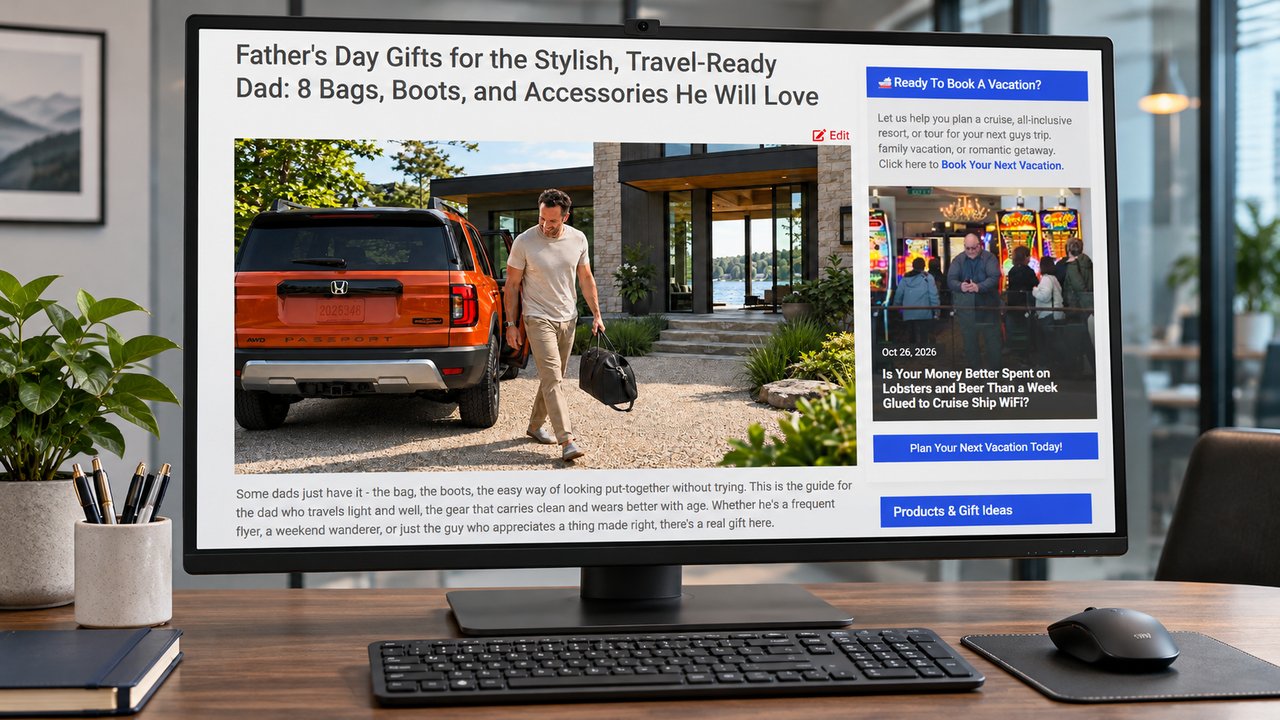
FlowContent, the publishing platform I built for my network of travel and lifestyle sites, exists because AI-generated articles failed me in a very specific way: they were fast and cheap, and they had nothing original to say. Here is how I moved from writing everything myself, to drowning in AI slop, to building tools that gather interviews, surveys and roundups from the people who have the stories, and why original content is where small publishers can still stand out.
What I learned moving from AI volume to original, sourced content.
- AI writing without original input stays soulless no matter how good the prompt is, because it has nothing new to work with.
- The people with the best stories are already pitching you, and an open roundup or interview gives them a way in that doesn't start with a rate card.
- Interviews with experts double as internal linking material, giving every future article a source one step away from "I was there."
- A single survey of tourism professionals produced data no competitor has, with slow but positive results.
- You can start this week with a BCC email list and no software at all.
Before 2019, I personally wrote nearly everything on my sites. Back then there was less pressure to publish huge volumes of content. That changed when competitors started using AI to pump out articles, and the choice became doing the same or getting buried.
How AI Volume Turned My Sites Into Slop
I followed the industry down the AI volume path, and the content that came out of it was total slop: horrific hallucinations and inaccurate facts. Even the pieces that were accurate when I wrote them in 2015 were way out of date by 2025.
So I started building tools to clean it up. FlowLifecycle looked at older posts that needed updates. ContentPulse was my first attempt to make checking automatic: every night it identified a batch of articles that needed fixing and built a brief on what to fix. That tooling later grew into other systems, and it exposed the weakness I couldn't prompt my way around. No matter how good your prompting is, AI writing is always going to be soulless, because it has nothing original.

What Is The Best Tea To Help Cure Hangover Symptoms
Tea for hangover relief: Target nausea, headaches, and dehydration naturally. Ginger, peppermint, and chamomile blends provide therapeutic benefits. Essential guidance for men seeking effective recovery.

Chai Tea Vs Green Tea: Comparing Health Benefits
Let's compare the differences between Chai Tea and Green Tea.

Oolong Tea Vs Green Tea Which Is A Better Choice For Men's Health
Comparison of the health benefits of Oolong Tea vs Green Tea and which is better for men's health.
Promoted by FlowAds
Buy Tea tea sales site

Finding the People Who Already Have the Stories
The question changed from "how do I fix this article" to "who has the stories?" Where is the cool stuff that I don't have time to go do myself? The answer came down to what I've always loved about this job. I love roundups, I love doing interviews and I love talking with people and building relationships. That is where FlowContent came together.
FlowContent runs interviews, surveys and roundups as campaigns: an open call, a simple form or interview, the responses collected in one place, follow-ups, thank-you notes and a link back to the published article. It's about destroying the friction that exists right now in publishing and promoting great stories.
Before, when a PR person pitched me a great story or a cool product, the honest answer was "man, that's a great story or a cool product, but I can't do anything unless you pay me." Now I can point them to a roundup that's open or an interview. Not every PR person takes it, and that's fine. But I love getting emails like "Thanks James, the roundup came out great, we shared it on our Facebook" and "Wow James, our client loved it and put it on their media page." That's brand building, it's creating authority and, honestly, it feels good.
The reality I discovered is that most small publishers fail not because they don't have something good to say. They fail because nobody knows they exist.
Cross-Referencing Expert Interviews Gives You Sources Nobody Else Has
Every interview becomes a resource for future articles through internal linking. If I'm writing about a trip in Pennsylvania, I can pull a quote from Laurel Highlands Tourism, one of the contributors to our research, instead of citing the same bar everyone else cites because it now shows up in ChatGPT.
That gives the article expertise that is one step away from being able to say "I was there." An expert talking about their own town is just as legitimate as a travel writer who visited once.
Original Survey Data and a Platform of Base Hits That Build Authority
The clearest example of original data is our guys trip survey. For the 2026 ManTripping Guys Trip Report, we invited more than 1,000 tourism and travel-industry leaders across North America to tell us what they see in men's group travel, and 167 took part. The results included numbers nobody else had published: demand up or holding steady for 96 percent of respondents, and only 6 percent of the destination marketing organizations surveyed with a dedicated guys trip strategy.
The results have been slow but positive, and they give us content nobody else has. That's the point. FlowContent isn't a one-and-done campaign tool. As a concept, it's a platform for building authority over time.
We have applied it to travel and lifestyle, but the same model works for a hyper-local media site featuring the people in a small town, or a farm blog built around farming experts. We built it for internal use, and we're considering ways to use it for client work as well.
My goal right now is building and refining the tools and creating stronger relationships. Each campaign produces something useful: free product for reviews, trip invites, positive feedback, social shares and links. This isn't about hitting a home run every time. It's about building a platform of base hits that creates a solid foundation.
What Still Breaks, and How We Fix It
FlowContent is a work in progress. Some needs don't show up until they block us when we try something new, and honestly, that's the fun of it.
Our holiday gift guides brought in around 300 submissions, compared with 20 to 30 for a typical roundup, and that volume broke things that had worked fine at smaller scale. The fix was to sit down with my AI agent team, build a plan and create the fixes.
The biggest remaining issue is friction on the contributor side. No matter how easy the process feels to us, it's still hard for people to believe an interview really takes only 15 to 20 minutes, or to know what a good response looks like. We keep working on both.
Start Small and Begin This Week With a BCC List and an Email
You don't need custom software to start gathering original content. The easiest first step is a BCC email to the contacts you already have: "I'm working on a roundup of the best all-inclusive resorts. Do you have anything special that we could include in our blog post this week?"
The step up is to connect Claude or ChatGPT to Gmail through an MCP connector. The AI can generate the request emails, pull the responses back in and turn them into a first draft of the article, which you then edit, check and make your own.
Before your first send, decide what you will give back: a link to the published piece, a thank-you note with something personal in it, and a reason to come back for the next roundup. The responses become the content, and the follow-up turns contributors into people who come back.
About the Author: James Hills is the founder of FlowMediaMarketing.com and runs a network of travel and lifestyle publications including ManTripping.com and CruiseWestCoast.com, where expert interviews, surveys and roundups are now at the center of how new content gets made. For media inquiries on original content strategy and AI-assisted publishing, contact James at FlowMediaMarketing.com.